

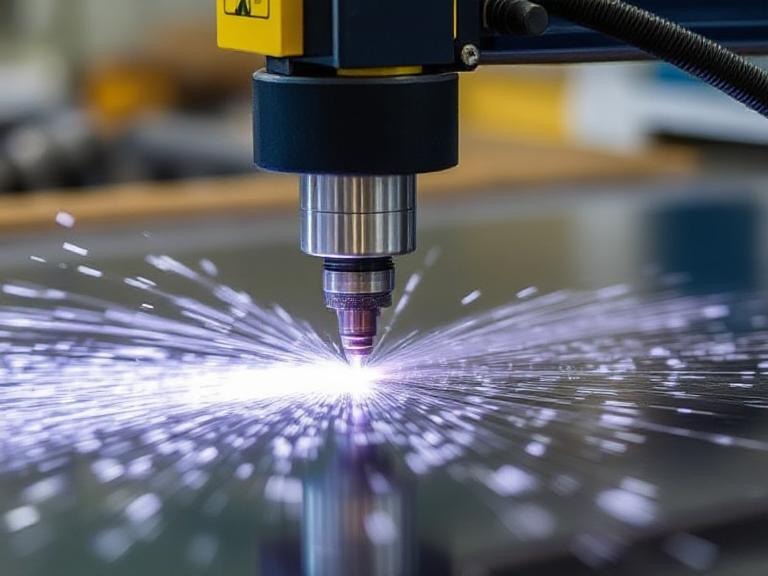
Benefits of Waterjet Cutting
Waterjet cutting stands out as one of the most versatile and material-friendly cutting methods available today. Its greatest advantage is the “cold-cutting process“. There is absolutely no heat-affected zone (HAZ), which means no thermal distortion, no material hardening, no microcracks, and no change to the intrinsic mechanical or chemical properties of the workpiece. This makes it indispensable for cutting heat-sensitive materials like aerospace alloys, hardened tool steel, tempered glass, and plastics that would warp or degrade under laser or plasma cutting. Second, unmatched material versatility allows a single machine to cut metal, stone, glass, ceramics, composites, rubber, foam, and even food, all without changing tools or optics, simply by adjusting the cutting speed and abrasive flow.

Waterjet Cutting Standard Tolerances
Standard abrasive waterjet cutting delivers typical dimensional tolerances of ±0.1‑0.25 mm per ISO 2768‑m norms. Precision drops as material thickness rises, bringing minor edge taper. Thinner workpieces can reach ±0.05 mm at slower feed rates. Kerf offset must be considered in CAD for accurate finished‑part dimensions.
Material Thickness |
Standard Tolerance |
Precision Tolerance |
|---|---|---|
0.5 – 6 mm (thin sheet) | ±0.05 mm (±0.002") | ±0.025 mm (±0.001") |
6 – 20 mm (medium plate) | ±0.10 mm (±0.004") | ±0.05 mm (±0.002") |
20 – 50 mm (thick plate) | ±0.20 mm (±0.008") | ±0.10 mm (±0.004") |
50 – 100 mm (heavy plate) | ±0.40 mm (±0.016") | ±0.20 mm (±0.008") |
100 – 200 mm (very thick) | ±0.80 mm (±0.031") | ±0.40 mm (±0.016") |
Waterjet Cutting Service Capabilities
Our waterjet cutting service uses abrasive waterjet for multi‑material parts. It delivers complex geometry and tight tolerance with no heat distortion. Accepts CAD files for prototypes and small‑batch production runs.

Pure waterjet cutting uses a high-pressure stream of water (up to 60,000 psi), forced through a small nozzle, to erode and cut soft materials like foam, rubber, textiles, and food. Unlike abrasive waterjet cutting, it contains no added abrasive particles, making it ideal for precise, contamination-free cuts on delicate or heat-sensitive materials.

Abrasive waterjet cutting mixes high-pressure water (up to 90,000 psi) with garnet or other abrasive particles to cut hard materials like metal, stone, glass, and composites. The abrasive boosts cutting power, enabling clean, precise cuts through thick, dense materials without heat-affected zones, making it ideal for industrial fabrication and precision machining applications.

5-axis cutting moves the tool along five simultaneous axes (X, Y, Z plus two rotational), allowing it to approach a workpiece from virtually any angle. This enables precise cutting of complex, curved, or beveled shapes on 3D parts in a single setup, common in aerospace, automotive, and mold-making industries.

Multi-head cutting uses multiple cutting heads operating simultaneously on the same machine, allowing several parts to be cut in parallel from one material sheet. This significantly boosts throughput and production efficiency, reduces per-part cycle time, and is widely used in high-volume manufacturing where identical or varied parts are needed quickly.
Waterjet Cutting Machine Specifications
Waterjet cutting machines feature ultra‑high‑pressure pump, CNC traverse system and abrasive head. Standard positioning accuracy reaches ±0.1 mm. Working table size is customizable. 3‑axis or 5‑axis options support diverse cutting tasks for varied material thicknesses.
Type |
Specifications |
|---|---|
Cutting bed size: | Up to 2,000 × 4,000 mm (6.5' × 13') for large-format sheets and plates |
Maximum material load: | 1,465 kg/m² (300 lbs/sq ft) |
Pump power: | 50–150 HP direct-drive and intensifier pumps |
Pressure range: | 40,000 – 90,000 PSI (2,800 – 6,200 bar) |
Software: | Advanced CAD/CAM with automatic nesting and DFM analysis |
File formats accepted: | DXF, DWG, STEP, IGES, SolidWorks, PDF drawings |

Waterjet Cutting Materials
Waterjet cutting supports versatile material processing. Waterjet cuts metal, stone, ceramics and composites; pure waterjet slices soft foam, rubber and textiles. No heat‑affected zone eliminates thermal distortion. Brittle materials need stable fixturing. Tune abrasive grit and cutting speed to gain clean cuts for varied hardness and thickness.
Visit our materials page for a full list.
Lead Time for Waterjet Cutting Service
Lead time for waterjet cutting service depends on part complexity, quantity and material availability. Simple custom‑cut parts usually ship within 2‑5 business days. Complex abrasive waterjet projects with large batches require longer production schedule. Material stock‑outs will extend turnaround. Rush order options are available for urgent waterjet cutting requests.
Production Type |
Standard Lead Time |
Rush / Expedited |
|---|---|---|
Prototypes | 2 – 3 business days | 24 – 48 hours |
Low Volume | 3 – 5 business days | 1 – 2 business days |
Medium Volume | 5 – 10 business days | 3 – 5 business days |
High Volume | 1 – 3 weeks | 5 – 10 business days |
Thick material (>50 mm) | Add 2–3 business days | Add 1–2 business days |
Parts with Surface Finishing | Add 3 – 7 business days | Add 2 – 4 business days |
Waterjet Cutting Surface Finishes
Waterjet cutting surface finishes vary with abrasive waterjet settings. Slower cutting speed delivers smoother edge quality; faster feeds produce coarser textures. No thermal burn occurs. Secondary finishing may be needed for high‑spec parts to remove slight taper and achieve precise surface requirements.
As-Fabricated (Raw / Mill Finish)
Passivation process
Default finish straight from sheet metal fabrication cutting, bending, and welding with no secondary treatment. Visible shear cut edges, bend lines, weld seams, and native mill finish. Suitable for structural brackets, internal frames, and functional components where cosmetic appearance is secondary to strength and cost.

Brushed / Grain Finish
Passivation process
Mechanical brushing with abrasive belts creates a uniform directional linear grain pattern across sheet metal. Hides scratches and surface imperfections, produces a consistent semi-matte appearance. The most popular decorative finish for stainless steel and aluminum — used for kitchen equipment, architectural panels, appliance housings, and consumer product enclosures.

Polished / Mirror Finish
Passivation process
Mechanical polishing with progressively finer compounds and buffing wheels produces a highly reflective, mirror-like surface. Removes all scratches, tool marks, and imperfections achieving the highest possible gloss. Used for stainless steel food service equipment, medical instruments, architectural trim, decorative panels, and premium consumer products requiring a flawless reflective finish.

Bead Blasted / Satin
Passivation process
High-pressure blasting with glass beads or aluminum oxide creates a uniform matte satin, non-reflective surface. Hides weld seams, scratches, and surface inconsistencies, produces a consistent fine grain texture. Used for aluminum and stainless steel brackets, enclosures, medical devices, and industrial components where a clean, uniform, non-glare matte appearance is desired.

Powder Coated
Passivation process
Electrostatic dry powder paint followed by thermal curing creates a durable, uniform matte or satin finish. Available in any RAL color, provides excellent corrosion and scratch resistance, thicker and more durable than wet paint. The most popular protective/decorative finish for steel and aluminum enclosures, electrical boxes, machine housings, and outdoor industrial equipment.

Anodized (Aluminum)
Passivation process
Electrochemical process creates a hard, corrosion-resistant, dyeable aluminum oxide layer on aluminum sheet metal. Available in any color (black, blue, red, clear), provides wear protection and improved corrosion resistance. Widely used for aluminum enclosures, electronic housings, aerospace components, and architectural panels requiring a durable, colored, corrosion-resistant finish.

Galvanized (Steel)
Passivation process
Hot-dip galvanizing immerses steel in molten zinc, creating a thick, corrosion-resistant zinc-iron alloy coating with a characteristic spangled crystalline pattern. Provides excellent long-term corrosion protection for outdoor and structural applications. Used for steel brackets, structural frames, outdoor equipment, fencing, and any steel component requiring durable rust protection in harsh environments.

Painted / Wet Paint
Passivation process
Conventional spray painting with liquid paint (acrylic, epoxy, polyurethane) applied over a primed surface, available in any custom color and gloss level. Provides good corrosion protection and decorative color ideal for parts requiring custom color matching, intricate masking, or multi-color finishes where powder coating is not practical. Used for industrial equipment, automotive parts, and custom enclosures.

Black Oxide (Steel)
Passivation process
Chemical conversion coating creates a uniform matte black finish on steel sheet metal. Minimizes light reflection, provides mild corrosion protection, and does not affect dimensional accuracy. Used for steel tooling, fixtures, optical components, and hardware where a non-reflective black surface is desired often combined with oil or wax topcoat for enhanced corrosion protection.

Passivated (Stainless Steel)
Passivation process
Chemical treatment (citric or nitric acid) removes free iron and contaminants from stainless steel surfaces, restoring and enhancing the protective chromium oxide layer for improved corrosion resistance. Does not change appearance, dimensions, or surface texture. Standard post-fabrication treatment for all 304/316 stainless steel parts — especially medical instruments, food service equipment, pharmaceutical components, and outdoor stainless applications.


